Monday, 22 November 2021

Lupine Publishers | An Investigation of Turkish Specialist and Practitioner Doctors’ Empathy and Cognitive Flexibility Levels and Interpersonal Relationship Styles

 Lupine Publishers | Scholarly Journal Of Psychology And Behavioral Sciences


Introduction

The interlocked relationship between mind and body has increasingly resulted in modern medical practices’ use of biopsycho- social and patient-centered models that emphasize various psychological and environmental factors [1-3]. In particular, patientcentered approaches are characterized by a serious consideration of patients’ views, preferences, values, and economic resources [4]. In addition to positively affecting various medical outcomes and patient satisfaction levels, patient-centered approaches have been shown to reduce the use of healthcare services, diagnostic tests, prescription, referral, and hospitalization, along with total annual healthcare expenses [5,6]. Given that visiting a physician may in itself induce considerable worry and anxiety in patients [7], physicians’ interpersonal communication competencies and styles can directly influence patients’ self-expression by providing them with a sense of being listened to and understood, which in turn acts on several factors such as patients’ anxieties about their illness, hope for a cure, and adherence to the treatment [8]. In the treatment of somatic diseases, talking about disease perception reveals the therapeutic effect of talking [9]. In this regard, empathy refers to a “cognitive quality” that by its interpersonal nature involves a physician’s capacity to understand and communicate about patients’ experiences, anxieties, and viewpoints [10,11]. Empathy has been reported to reduce patients’ anxiety and stress levels and to considerably influence positive health outcomes [12]. More specifically, physicians’ empathy has been shown to be significantly associated with diabetes patients’ clinical outcomes and result in shorter periods of the common cold [13-16].

As these studies point to a concrete and measurable effect in the immune system induced by a positively experienced subjective feeling, they further substantiate the strong relationship between mind and body. Among the factors that have transformed the physician-patient relationship from Emanuel’s paternalistic model to a conciliatory model are the rising socioeconomic level with social development, medical technologies that improve the quality of life, the development of patients’ rights, patients’ greater knowledge of their rights, developments in the concept of seeking rights, physicians and patients putting more value on human rights, the widespread implementation of legal responsibilities and sanctions on physicians and patients, legal obligations, the application and dissemination of the understanding of quality in healthcare, rising health literacy, and the existence of complaint mechanisms through communication centers of public institutions [17]. Studies supporting patients’ empathy expectations in Turkey [18-23] as well as focusing on patient-physician communication show that empathy stands out as a very important element, sometimes alone and sometimes together with other variables [24-26].

There are many studies that evaluate empathy education and empathetic attitudes of students in the basic medical education process in medical schools and investigate how empathy can be developed [27-33]. As another significant variable of this study, cognitive flexibility is regarded as a form of fluid intelligence marked by the skill of providing alternative solutions to different situations [34]. This construct is closely related to the neuro-psychological concepts of role- and perspective-taking, which entail numerous cognitive flexibility dimensions such as understanding others, selecting appropriate behavior, thinking about and generating different ideas, possessing a repertoire for different responses, and exchanging ideas with others in decision-making [35]. Literature on cognitive flexibility related to personnel working in the healthcare field is quite limited. A study on nurses found that coping skills and flexibility were positively correlated with psychological adjustment [36]. A study of medical students and residents showed that incorporating cognitive flexibility and perspective-taking skill instruction has implications for reducing conflict and stress, as well as improving wellness levels [37]. Empirical studies demonstrate that increased cognitive flexibility is linked to reduced levels of experiencing social difficulties, stress, depression, anxiety, and rage [38-42]. Conversely, cognitive flexibility has been found to be related to positive personal outcomes such as critical thinking, selfesteem, social skills, self-competence, and coping with stress [43- 45].

Although limited amount of evidence exists in the literature, there are several empirical studies that substantiate the relationship between empathy and cognitive flexibility. In one major example, neurological patients with various etiologies and cerebral lesions were found to manifest significantly lower empathy than healthy normal adults. The same study found significant correlations, ranging from 0.5 to 0.6, between cognitive flexibility and empathy scores [46]. These data support the idea that cognitive thinking may be closely linked to empathic behavior either via granting a precognitive skill or by being part of another common basic process. The present study is designed to make comparisons between Turkish practitioner and specialist physicians in terms of empathy, cognitive flexibility, and interpersonal relations styles. In so doing, it tests the question of whether practitioners’ long-term interactions with their enrolled patients (i.e. spending more time with them, knowing them better) or specialists’ longer training histories are correlated with increased empathy and cognitive flexibility levels.

Methods

Participants

It is included family physicians, who have completed 6 years of medical training and specialists who have completed an additional 5 years. Family physicians see the patients registered with them and specialists see patients who can make an appointment anytime and anywhere. Inclusion criteria for data collection were determined as for specialists who work as clinician. Branches of specialists: 5 orthopedics, 8 chest diseases, 1 neurology, 4 obstetrics, 3 infectious diseases, 2 internal medicine, 1 physical therapy, 1 pediatric, 3 ENT, 2 urology. General practitioner work as clinician. Thus, the sample of the present study comprises 60 participants, i.e. 30 practitioners and 30 specialists. Demographically, 40% of the practitioners and 47% of the specialists were women. Additionally, 90% of the practitioners and 97% of the specialists were married. The age average for practitioners and specialists was 45.5 and 43.2, respectively. As mentioned above, participants’ working posts involved family health centers and state or training and research hospitals. Paper-and-pencil questionnaires were filled out by volunteer participants themselves in the major cities of Istanbul and Ankara between January and April 2019.

The questions that the study aims to measure in terms of the variables included are as follows:

Do long-term interaction and being familiar affect physicians’ interpersonal relationship styles?

Does residency training affect specialist’ relationship styles?

Assessment Instruments

To address its research questions, this research employed the Jefferson Scale of Physician Empathy, the Cognitive Flexibility Inventor, the Interpersonal Relationship Scale, and a sociodemographic form.

Jefferson scale of physician empathy

The Jefferson Scale of Physician Empathy (JSPE) is a 20-item, 7-point Likert-type scale. In a sample of medical doctors, its internal consistency was found to be around .80. In the Turkish context, this scale was adapted by Malkondu in 2006 and its validity-reliability study was done on a sample of dentists [47].

Cognitive flexibility inventory

Developed by Dennis and Vander, the Cognitive Flexibility Inventory involves 20 questions and two subscales entitled “alternatives” and “control” [28]. The alternatives subscale comprises 13 items that tap into the extent to which an individual is able to find alternative solutions to difficult conditions or can form alternative explanations for life situations and people’s behaviors. The control subscale is constituted by items that measure to what extent these predicaments can be controlled [48]. The Cronbach’s alpha values for alternatives and control subscale were reported as .91 and .84, respectively. Higher scores are indicative of increased cognitive flexibility [28]. Validity and reliability research for the scale’s Turkish version was undertaken, who found Cronbach’s alpha values of .90 for the whole scale, .89 for the alternatives subscale, and .85 for the control subscale.

Interpersonal relationship scale

Developed by this 31-item, 3-point Likert-type scale assesses individuals’ interaction styles with others. Two subscales measure nurturing and restraining styles, respectively. Nurturing relations involve skills such as expressing one’s needs in an open manner, treating the other person with a respectful and accepting style, and employing a constructivist discourse. Conversely, restraining communication styles are marked by behaviors such as selfrighteousness, condescension, short temper, verbal abuse, and mockery. The scale has been used in many studies and evidence has been obtained that it is valid and reliable [49-52] Subscales for nurturing styles, in turn, tap into open and respective styles, while the restraining styles subscale further comprises egocentric and condescending styles. The internal consistency coefficient for the whole scale was measured as .79. Cronbach’s alpha values for open, respectful, egocentric, and condescending styles were .73, .70, .56, and .78, respectively.

Results

As reassessed from the data, the Cronbach’s alpha coefficient for the empathy scale turned out to be .847, while the cognitive flexibility subscales of control and alternatives had internal consistency values of .653 and .749, respectively. The interpersonal relationship subscales’ alpha coefficients ranged from 0.653 to 0.749. In terms of between-group comparisons, Mann-Whitney U tests indicated that, although specialists’ empathy level was higher than practitioners, the difference was not statistically significant. With respect to cognitive flexibility comparisons, Mann-Whitney U and t-tests substantiated that only the cognitive flexibilityalternatives subscale was significantly higher in specialists than practitioners. The associated values for these comparisons are shown in Tables 1,2. Interpersonal relationship style comparisons centered on nurturing (open-respectful) and restraining (ego centric-condescending) styles. As scores for open and egocentric styles were normally distributed for both groups, t-tests were employed for comparisons. Conversely, distributions for respectful and condescending styles were not normally distributed. Thus, the Mann-Whitney U test was preferred for comparisons in these domains. Accordingly, results indicated that specialists received significantly higher scores than practitioners in nurturing styles and significantly lower scores in restraining styles [Table 3].

Table 1: Comparison of empathy levels between specialists and practitioners.

Lupinepublishers-openaccess-journals-psychology-behavioral-science

According to the Mann-Whitney U test, although specialists’ empathy levels were higher than practitioners’, this difference was not statistically significant, (p>0.05).

Table 2: Comparison of cognitive flexibility levels between specialists and practitioners.

Lupinepublishers-openaccess-journals-psychology-behavioral-science

*p<0.05

According to the Mann-Whitney U and t-tests, alternatives subscale was the only statistically significant difference, and scores were higher for specialists, (p<0.05).

Table 3: Comparison of interpersonal relationship styles between practitioners and specialists.

Lupinepublishers-openaccess-journals-psychology-behavioral-science

*p<0.05

According to Mann-Whitney U and t-tests, significant differences were found in terms of open, respectful, and condescending styles between practitioners and specialists. Specifically, specialists displayed higher open and respectful style scores and lower condescending style scores.

Spearman-Brown correlational analyses revealed a significant positive association between empathy and cognitive flexibility for practitioners. Similarly, for this group, the relationship between empathy and respectful relationship styles was also significantly positive, while the correlation between empathy and condescending styles was significantly negative [Table 4]. Specialists’ correlations between empathy and cognitive flexibility and relationship styles were not significant [Table 5]. Regarding correlations between cognitive flexibility and relationship styles, for practitioners, control and alternatives subscales were moderately associated with respectful styles. For specialists, cognitive and alternatives subscales were significantly related to open styles. For this group, an alternatives subscale was also moderately related to respectful styles. These significant positive associations are shown in Tables 6 and 7, respectively. Gender and marital status were not significantly related to specialists’ or practitioners’ empathy tendencies, relationship styles, cognitive flexibility total, or subscale scores. For practitioners, having longer careers contributed significantly to increased empathy, cognitive flexibility levels, and nurturing styles. For this group, age and cognitive flexibility was also positively related. For specialists, age and working duration were not significantly correlated with empathy levels, relationship styles, or cognitive flexibility levels. These results are shown in Table 8. According to the Spearman-Brown analysis, significant moderate associations were found between cognitive flexibility alternatives and respectful and condescending styles that were positive and negative in nature, respectively. There was also a positive moderate correlation between cognitive flexibility control and respectful style.

Table 4: Correlations between empathy and cognitive flexibility and empathy and interpersonal relationship styles in practitioners.

Lupinepublishers-openaccess-journals-psychology-behavioral-science

*p<0.05

According to the Spearman-Brown analysis, positive significant correlations were found between empathy and cognitive flexibility control and alternatives subscales. Empathy was also positively related to respectful styles. The sizes of these relations were moderate. Another moderate correlation was found between empathy and condescending styles that was negative in nature.

Table 5: Correlations between empathy and cognitive flexibility and empathy and interpersonal relationship styles in specialists.

Lupinepublishers-openaccess-journals-psychology-behavioral-science

Table 6: Correlation between cognitive flexibility and interpersonal relationship style in practitioners.

Lupinepublishers-openaccess-journals-psychology-behavioral-science

*p<0.05

According to the Spearman-Brown analysis, significant moderate associations were found between cognitive flexibility alternatives and respectful and condescending styles that were positive and negative in nature, respectively. There was also a positive moderate correlation between cognitive flexibility control and respectful style.

Table 7: Correlation between cognitive flexibility and interpersonal relationship style in specialists.

Lupinepublishers-openaccess-journals-psychology-behavioral-science

*p<0.05

According to Spearman-Brown correlation, the cognitive flexibility alternatives subscale was positively and moderately related to open and respectful styles. The cognitive flexibility-control subscale was positively correlated to open style.

Table 8: Associations between Empathy/Cognitive Flexibility and Age/Working Duration.

Lupinepublishers-openaccess-journals-psychology-behavioral-science

*p<0.05s

Discussion and Conclusion

Discussion

Findings revealed specialists’ empathy and cognitive flexibility scores were generally higher than practitioners’, yet the only statistically significant dimension was cognitive flexibilityalternatives in specialists.

In interpersonal relations, significant differences in terms of open, respectful, and condescending communication styles demonstrated that, compared to practitioners, specialist physicians were again more competent in these areas. These findings do not corroborate our tentative assumption when undertaking the study, namely that due to familiarity and longer interactions with their patients, practitioners should exhibit higher empathy, cognitive flexibility, and communication competence. Our particular pattern may have stemmed from various factors: First, with respect to cognitive flexibility, due to certain preexisting cognitive skills, individuals who become specialists may be predisposed to more competently assess alternatives in particular situations and problems. Indeed, [53] proposed that the predominant characteristic of experts is the ability to manipulate versatile mental representations, which in turn enables them to adapt better to environmental changes and use their knowledge more efficiently among different tasks. Alternatively, one may consider the effect of specialists’ education in terms of both different cognitive skills acquired and being exposed to courses on patient-doctor interactions. It is conceivable that different specialist branches, the cultures of hospitals and medical schools, socioeconomic status, or even cities of residence may play a role in augmenting or hindering cognitive flexibility, empathy, and interpersonal relationship style. In this regard, future studies may include these variables to determine both their unique and interactive effects for various professionals in the medical field.

Although not displaying a statistically significant difference, higher empathy levels and interpersonal relations competence of specialists may be linked to particular predicaments of the medical system in Turkey. In Turkey, practitioners regularly receive a burdensome number of registered patients. In this sense, it is reasonable to suggest that practitioners may have developed certain emotive strategies to mitigate the emotional burden that accompanies personal interactions with their patients. Alternatively, the mundane and repetitive tasks of referrals to specialists and renewing prescriptions may also hamper the tendency to develop a genuinely empathetic understanding of patients’ problems and emotional states. Conversely, specialists in Turkey accept additional patients in return for extra income, which offers them an opportunity to control the overburden they experience. These points highlight the importance of considering the significant role that the nature of healthcare systems may play in determining the quality of interpersonal communication and empathetic interaction. It is particularly telling that both specialist and practitioner empathy scores in Turkey are well below those reported by international studies, which lends support to the idea that predicaments in healthcare systems may greatly compromise cognitive flexibility and empathy. As compared to our scores of 101.30 for specialists and 97.63 for practitioners. Reported international physicians’ empathy levels in human-centered and technology-centered specialty fields as 112.9 and 106.9, respectively. Average physician empathy levels were found to be 120 in the United States [54-60].

In another major finding, in a practitioner sample within group analyses, the present study substantiated empathy’s significant relation to cognitive flexibility and interpersonal relations. These findings resonate with a prior study on Turkish university students [52] in which, as in this study too, empathy was found to be positively associated with open and respectful styles and negatively linked to condescending styles. Since in our study, empathy in specialists was not correlated to cognitive flexibility or communication style, one may consider the idea that, for specialists, the more intermittent and impersonal nature of doctor-patient interactions in the Turkish healthcare system enables the acquisition of satisfactory communication skills mainly via cognitive skills. Conversely, for health professionals such as practitioners and nurses who interact more closely with patients, communication skills may be induced mainly along the path of empathy.

Notwithstanding fields or branches among health professionals, the present study can be considered a noteworthy contribution to international research that investigates questions regarding empathy, cognitive skills, communication, and patient outcomes for healthcare professionals and workers at large. Indeed, a recent upsurge in international studies started to increasingly point to relations of these kinds. To give a few examples, prior research found a positive relationship between empathy and interpersonal relations in nursing students [61,62] and similarly posited positive relationships among empathy, perspective-taking, nurturing care, and friendly-harmonious relationship types in medical students [63]. Recently a strong relationship was suggested between empathic thinking and perspective-taking [64]. Hence, the present study lends support to the idea that the empathic and communicational skills of medical professionals should be one of the major avenues of research for promoting patient outcomes [65- 67].

This study offers ideas as to why training intervention is needed to improve communication and interpersonal relationships, and also includes suggestions about what the training program should cover. Some limitations should also be noted. The rather small sample sizes, including 30 participants for each group, and nonrandom, voluntary sampling procedures in this study should be considered caveats preventing satisfactory representativeness and generalizations around the globe. Additionally, variables such as doctors’ and patients’ personality traits and cultural and socioeconomic backgrounds were excluded from analyses. Lastly, our measuring instruments relied on self-report scales and are thus subject to biases rooted in the conveyance of subjective experience. These points should be taken into account by researchers while drawing cautious inferences for future research studies.

Conclusion

All in all, this study provides support to bio-psycho-social model patient-centered approaches and suggests their adoption positively influences patients’ psychological, mental, and physical health. Hence, the cultivation of an understanding recognizing the importance of interpersonal relations, communication skills, and interaction between the mind and body seems to be a worthwhile endeavor in the medical field. The long-term articulation of costeffective methods in healthcare systems – primarily training in factors promoting interpersonal relationships such as empathy and cognitive flexibility – would positively contribute to more efficient processes of diagnosis and therapy based on fulfilling interactions between physicians and patients.

 Read More Lupine Publishers Psychology And Behavioral Sciences Journal Articles:

https://lupine-publishers-psychology-journal.blogspot.com//


Friday, 12 November 2021

Lupine Publishers | Generalisation Abilities of Learned Tasks in Horses (Equus Caballus) are Influenced by the Experimental Context

 Lupine Publishers | Scholarly Journal Of Psychology And Behavioral Sciences


Abstract

The generalisation of responses to different stimuli depends on the ability to create associations between stimuli. Stimulus generalisation can be performed for different stimuli or for different contexts in which the same stimulus is perceived. This study investigated the stimulus-generalisation abilities of horses in different contexts. Sixteen horses were involved in this study. During the learning activity (LA), horses were given the chance to choose between two geometrical figures (a triangle and a circle) to obtain a food reward; the circle always corresponded to the correct choice. The rule was considered learned if a horse was correct more than 70% of the time and made 4 consecutive correct choices. Then, a generalisation test (GT) with ten devices (5 circles, 5 triangles) was created to test generalisation. Only eleven horses respected the learning criteria and were included in the generalisation test. A significant difference in the number of correct choices between the learning activity and the generalisation test was observed (Wilcoxon signed-rank test, S=-33; p=0.001; LA: median=6, min=3, max=9; GT: median=3, min=0, max=5). There was no significant difference in the number of incorrect choices between the two tests (Student’s t test, t=-0.91; DF=10; p=0.384). A significant difference in the total number of choices between the two tests was observed (Student’s t test, t=2.56; DF=10; p<0.05). This experiment suggested limits in the capacity of horses to generalise a well-known task in different contexts. Because horses are often exposed to different environments or contexts, these results provide interesting and applicable knowledge for equine training and management.

Keywords: Behaviour; Equine Management; Generalisation; Horse; Learning; Welfare

Introduction

Horses are involved in many activities that have evolved over time and have changed the human-horse relationship [1]. Currently, horses perform sports and work activities that require adaptation to different contexts [2,3]. Horses are continuously challenged from physical and psychological perspectives and need to understand information provided by different persons or in different contexts [3,4]. To succeed in equitation, horses must learn different categories of exercises that are demanded by riders [5]. However, rider weight and posture, as well as the intensity applied to cues, are variable, which often results in differences in the information perceived by the horse [6]. Nevertheless, horses have an incredible behavioural flexibility that allows them to adapt their responses to the intensities of the cues given by different riders [7-10]. In addition, horses are athletes that often participate in competitions. Competition has been shown to induce physiological modifications in horses related to stress [5-11]. In competition, riders expect their horses to ignore external stimuli and to perform as usual in response to trained cues, which requires horses to generalise those cues from a training environment to a new context with multiple stimuli, such as the presence of the public [11]. The same situation might happen each time horses experience a change of ownership or a change in their living conditions [12]. To summarise, equine living conditions, training and competitions are full of different stimuli that challenge horses’ coping strategies [13-15]. In this context, it is important to understand that the generalisation of a stimulus implies that animals can form associations between different stimuli (Nicol, 2005). Horses are requested to generalise their responses to different stimuli over training, either through positive or negative reinforcement [7]. Stimulus generalisation could be performed from a group of stimuli with some similarities (e.g.: curved shapes) to a novel stimulus, which share the same similarities (e.g.: a circle) [16]. However, stimulus generalisation may also occur as the generalisation of a defined stimulus to different contexts [17]. Stimulus generalisation to new contexts appears to be difficult for horses [18-20].

Hence, the generalisation of a well-known stimulus to different stimuli is a factor in equine management and welfare [5]. This means that providing more efficient and reliable training methods for riders and owners can increase the welfare of horses [6,11]. Therefore, to efficiently improve horse welfare in equine husbandry and training, riders and owners should learn from scientific knowledge instead of following common beliefs [15]. The present study aimed to investigate the ability of equines to generalise a learned task, based on the same rule, to different contexts. We hypothesised that horses would show the generalisation of a learned stimulus to a novel test in a different setting.

Methods

Subjects

Sixteen horses (11 geldings; 5 females) older than eighteen months (11.5 ± 6.14 years) were involved in this study. All horses participated in equestrian activities on a daily basis. A visual examination was performed by a veterinary doctor to ensure that none of the animals had vision issues that could impair the tests. This study was divided into two learning events. All animals were submitted to a learning activity (LA), which was a reproduction of the test used. The LA intended to show the discriminative rule to the horses, enabling the selection of a population of horses that understood the rule before performing the second test. The discriminative rule was considered learned if a horse was correct more than 70% of the time and made 4 consecutive correct choices. Only horses that respected these criteria were included in the second test, which was a generalisation test (GT).

Material

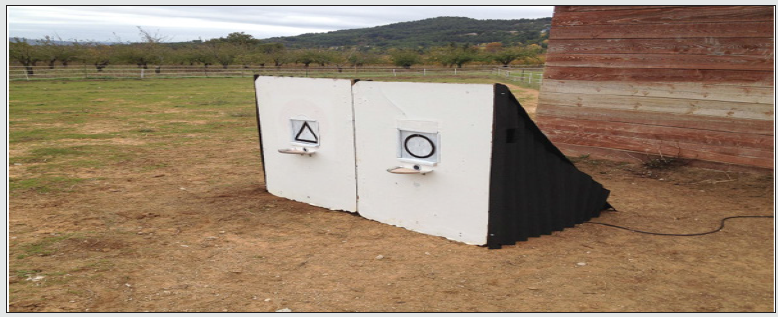
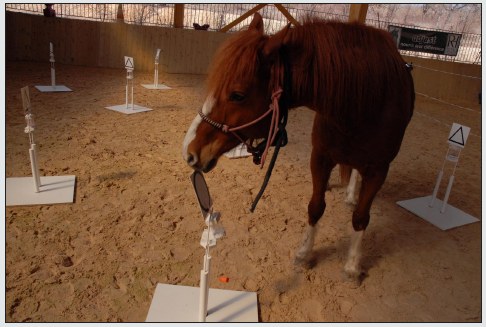
“Philbox”, the dispositive adapted and he was used for the LA in this experiment (Figure 1). The device consisted of two white panels; removable black shapes (a circle or a triangle) could be placed in front of the panels, and a hidden operator could insert treats on a food tray through a hole under each shape. A second operator led the horses to the panels. Ten “Pesadelo” devices were created to test the equine generalisation abilities (Figure 2). Each of these devices included a tilting mechanism, with one black shape painted on a white panel on the top (5 had a circle, and 5 had a triangle) and an inverted container on the bottom. Treats were placed in the containers, which each had a cover. For all devices marked by a circle, this cover was pierced such that the treats fell on the ground when the animals pushed or pulled the panel. For devices marked by a triangle, the cover was intact, so the treats did not fall when the animal pushed or pulled the panel. Some holes were created on the container to ensure that both devices had the same odour, regardless of cover type. There was a tray under each container. No operators were needed to run this device.

Figure 1: Philbox. The Philbox is a modified device for performing cognitive tests. The Philbox includes two removable geometrical shapes (circle and triangle) and a hidden operator who provides treats when the animals touch the panel with the correct shape.

Lupinepublishers-openaccess-journals-psychology-behavioral-science

Figure 2: Pesadelo. A Pesadelo is a device created to perform cognitive tests. The device includes a tilting mechanism with a shape-marked panel on one side and a treat in a container on the other side. To obtain the treat, a horse must push the panel (circle or triangle), such that the shape-marked panel tilts down and forward, the container tilts up and backward, and the treat drops onto the floor.

Lupinepublishers-openaccess-journals-psychology-behavioral-science

Procedure

A habituation session to the Philbox device was performed, as described. The setting was presented to the subjects, and spontaneous approaches and interactions with the device were rewarded with a treat. The session consisted of twelve efforts with the shapes removed from the devices. The initial phase of the session included 6 attempts (3 on the right and 3 on the left) using a treat on the panels as a lure; an additional reward was given each time the horses touched the panels. The horses then made 6 more attempts, for which they received a reward only upon touching the panels. A habituation session for the Pesadelo device was also performed to show horses the mechanism of pushing/pulling the panel to obtain treats. For this session, two devices with the shape panel replaced by a whole white panel were used. Horses were given 3 minutes of free contact with the two devices, in which any spontaneous contact with the panel was reinforced with a treat that felt from the container. For this purpose, each time a horse obtained a treat, an operator led the horse to the other device, while a second operator refilled the empty container with treats.

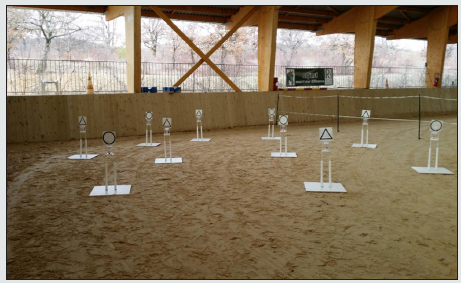
The LA were performed using the Philbox device and lasted five minutes for each horse. Horses had the possibility to choose between the shapes and received a reward (food treat) upon touching the correct shape (always the circle) with their noses (positive reinforcement). The development of a side preference was avoided by following predefined sequences of four figures, with a randomised order of appearance, thus avoiding any recognisable pattern. In addition, a food treat was hidden behind each shape to provide the same olfactory cue for both the circle and triangle. There was no limit to the number of attempts horses could perform during the 5 minutes of the test. Once a choice was made, horses were walked around by the operator and returned to the starting position. Thus, the horses that made choices faster could perform more attempts during the 5 minutes of the test. Each horse was led to a distance of 1.5 metres in front of the panels and then freed to interact with the setting. The operator stopped at 1.5 metres, stayed in a neutral position, and did not interact with the animal until a choice was made. Horses that made 70% or more correct choices, with at least 4 consecutive correct choices, were subsequently included in the GT. There was a time lapse of 48 hours between the two tests for all horses. The GT lasted 5 minutes for each horse. The setting consisted of ten Pesadelo devices (5 circles and 5 triangles) placed in a controlled testing area inside of a riding arena (Figure 3). Each device provided only one treat. The devices were randomly positioned in the setting area to permit the horse to easily access the two options (triangle and circle). Each horse was completely free in the testing area, and the operator left the riding arena and the visual field of the horse. The performance parameters for both tests included correct and incorrect choices and the total number of choices. For the GT, a choice was considered correct both the first and second time a horse pushed/pulled the same panel with a circle, even if the treat reward was only achieved during the first interaction. The same rule was applied for incorrect choices. If the horse returned to the same device a third time, that choice was not considered, neither correct or incorrect. Each horse was considered its own control.

Figure 3: Generalisation test setting. Ten Pesadelo devices were positioned in a controlled area to test equine generalisation capacities.

Lupinepublishers-openaccess-journals-psychology-behavioral-science

Statistical Analysis

Statistical analysis was carried out using 9.4 SAS software (2002-2012 by SAS Institute Inc., Cary, NC, USA). The significance threshold was classically fixed at 5%. Comparisons among the horses’ performances during the LA and the GT involved paired samples. To use the paired Student’s t test, normality was tested on the difference of the results in the LA and in the GT for the following parameters: “correct choices”, “incorrect choices” and “total number of choices”. For the “correct choices”, assumption of normality was not verified, so the non-parametric signed-rank Wilcoxon test was preferred. Normality was verified for “incorrect choices” and “total number of choices”; hence, the parametric Student t test was used.

Results

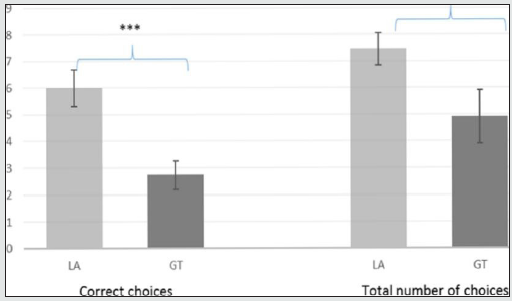
From the 16 initial horses, five did not learn the discriminative rule, so they were not included in the GT. The final population of horses comprised 11 subjects (7 geldings; 4 females). Only these horses were considered for the statistical analysis. Figure 4 compares these horses’ performances between the two tests. A significant difference in the number of correct choices between the learning activity and the generalisation test was observed (Wilcoxon Signed-Rank test, S=-33; p=0.001; LA: median=6, min=3, max=9; GT: median=3, min=0, max=5). Horses made two times fewer correct choices in the GT than in the LA. There was no significant difference in the number of incorrect choices between the two tests (Student’s t test, t=-0.91; DF=10; p=0.384).

Figure 4: Comparison of horses’ performances in the two tests (mean ± SD of choices). The learning activity is represented by light grey, and the generalisation test is represented by dark grey. ***: highly significant p-value, p=0.001; *: significant p-value, p<0.05.

Lupinepublishers-openaccess-journals-psychology-behavioral-science

A significant difference was observed in the total number of choices between the two tests, (Student’s t test, t=2.56; DF=10; p<0.05). Horses made a greater number of choices in the LA than in the GT.

Discussion and Conclusion

This experiment showed that horses who learned a specific discrimination task had a lower performance when the task was presented for the first time in a different context and setting. This result was emphasised by the decrease in the total number of choices and the number of correct choices between the learning and the GTs. The absence of a significant difference in the incorrect choices between the tests was probably related to the reduced total number of choices in the GT when compared to the LA. Horses made fewer attempts in the GT and often chose the wrong shape or device. The decrease in the horses’ performance between tests suggests that the generalisation of a learned task between contexts might require training and repetition. Even if the discriminative rule had been the same in both tests, the setting was completely different. The GT involved a three-dimensional setting with multiple devices, with only one positive reinforcement per device. For the LA, horses had panels simultaneously presenting all possible choices in their visual field, while for the GT, it was essential for horses to walk between the devices to reach all of them. The new context of the test can have impacted the performance in the GT. In addition, for the LA, an operator was always present. His presence could have represented a help for the animal. However, in our study, the operators were trained to stay in a neutral position and avoid any interaction with the horses to prevent them from influencing the horses’ choices. One could argue that the time (i.e. 48h) between tests could have a role in memorisation and, consequently, the generalisation of the rule. Nevertheless, memory in horses seems to be reliable and longlasting through life, as described by Hanggi and Ingersoll (2009).

Our results differ from those of Christensen et al. (2008), who conducted a study in which horses were submitted to a GT between stationary objects of the same colour with varying shapes in the same setting conditions. That study changed the rewarded shape between tests, while in the present study, the rewarded shape (the circle) remained the same between tests, but the setting was changed. Therefore, the generalisation of a well-known stimulus might depend on the context and environment [20]. This hypothesis is supported by the results, who created a setting with a lever near two buckets in an area open to horses. Horses learned that once they pressed the lever, they could have a food reward. Then, in a Y-maze test, a lever pointed to the direction of the correct side of the maze, where horses could find a food reward. They found that horses’ performance decreased from the bucket test to the Y-maze test. Even if the rule, i.e. the presence of a lever, was the same to obtain a food reward in both tests, the manner to follow the rule was different. Indeed, horses are accustomed to exploring new objects by touching or licking them; therefore, the exploratory behaviour of horses may have spontaneously provided the manners to use the lever to get a reward. However, in the Y-maze, this natural behaviour does not lead to any reward, so horses probably needed to find new coping strategies, which requires time and experience. Conversely, in our study, horses could obtain the reward by following the same rule with the same manner in the two tests, i.e. by pressing on a circle, which provided the same reliable information that horses could use for both tests. We observed a decrease in horses’ performances between the two tests, indicating that context features other than the manner to follow the rule can influence the generalisation abilities of horses.

Research findings are of great importance and should be considered in equine welfare and management because these findings often contradict commonly held beliefs about equine cognition and learning abilities [10-16]. Horses are part of a worldwide market and are moved across countries, which often implies regrouping with other conspecifics [18].

The ease of habituation to new living conditions is a serious welfare concern in horses that often results in misunderstandings in the human-horse relationship [4,6]. For example, if a horse is moved to novel husbandry conditions, its behavioural response to a well-known stimulus and the resulting coping strategies could be different from the original response and strategies, and these differences could be justified by the context modification, regardless of the horse’s previous habituation to that stimulus. The same problem could occur during competition because horses must perform previously learned exercises in new contexts [5]. In conclusion, this experiment suggested some limits in the capacity of horses to generalise a well-known task to different contexts. This study demonstrated that horses’ perception of different stimuli is context specific. Increasing our knowledge about the generalisation abilities of these animals is of great importance to improve equine management and training. Further research is still needed to fully understand horses’ generalisation abilities, especially focusing on the ability to generalise similar information in the same context, and to measure the influence of this ability on equine management and training.


https://lupinepublishers.com/psychology-behavioral-science-journal/fulltext/generalisation-abilities-of-learned-tasks-in-horses.ID.000214.php

https://lupinepublishers.com/psychology-behavioral-science-journal/pdf/SJPBS.MS.ID.000214.pdf

For more Lupine Publishers Open Access Journals Please visit our website: https://lupinepublishersgroup.com/

For more Psychology And Behavioral Sciences Please Click 

Here: https://lupinepublishers.com/psychology-behavioral-science-journal/

To Know more Open Access Publishers Click on Lupine Publishers

Follow on Linkedin : https://www.linkedin.com/company/lupinepublishers

Follow on Twitter   :  https://twitter.com/lupine_online


Friday, 8 October 2021

Lupine Publishers | Robots Among Us: Kazuo Ishiguro’s Klara and the Sun

 Lupine Publishers | Scholarly Journal Of Psychology And Behavioral Sciences


Introduction

Kazuo Ishiguro won the 2017 Nobel Prize for Literature. The award citation said of him that “in his novels of great emotional force, he has uncovered the abyss beneath our illusory sense of connection with the world” [1]. Four years later, his most recent novel, Klara and the Sun [2] was published. It is not about any kind of abyss. It is about connections among us humans, and also with other kinds of being. Although its protagonist, Klara, is a robot, this novel is far more psychological than some of the papers that are published in psychology journals. As with solar panels, Klara is powered by the Sun, an entity that not only provides her with electrical energy to move and think, but comes to take on, for her, a god-like significance. What, then, is the difference between her and biologically based human beings?

Robots and Artificial Intelligence

As we think about robots, we generally consider them to be artificial, made from silicon. But this isn’t the only kind of robot. In The Robot’s Rebellion [3], Keith Stanovich has pointed out that we humans are also robots. The genes, which we tend to think of as “ours,” are not really ours at all. It is we who are their vehicles. Genes have programmed us to carry them along and nourish them, so that they can reproduce and proliferate. It’s not gods that are immortal, it’s these strands of DNA: the genes. So, as Stanovich proposes, we need to rebel, not just allow ourselves to be programmed by genes but, instead, to make our own human decisions. Ishiguro’s novel is about what kind of decisions we make for ourselves and others, and for what purposes. It prompts us towards thinking: what, or who, is a robot? What does it mean to be a human? What does it mean to understand someone fully, and to love them? Some people have wondered whether robots based in artificial intelligence (AI) will not just learn but will do so better than any other kind of being and, in this way, become more intelligent that humans, and perhaps take over the world. Looking back through history, with its wars and colonialism, thinking about income inequality and climate change, we may wonder how well we humans have done, in charge of the world: not nearly as well as we might have wished. But, with the coming of more effective forms of artificial intelligence, including “Deep Learning,” in which computational artificially intelligent systems do not need to be trained, but construct intuitions by taking in many examples from which they change their systems’ inter-neural connections [4], perhaps we might collaborate with them and learn, ourselves, to think more clearly. The physicist Stephen Hawking has said that “Success in creating AI would be the biggest event in human history. It might also be the last, unless we learn how to avoid the risks” [5].

Perhaps this idea of artificial robots taking over the world is a Western view. Another view is, as Ishiguro suggests, that robots might be our friends. The emergency room physician, Brian Goldman, wrote a book called The Power of Kindness [6]. In one chapter he describes a visit he made to Japan, to investigate the making of robots who look after people who can’t look after themselves. With increased numbers of such people, as many of us become older, when diseases that used to kill us become chronic disabilities, more of us need to be cared for. These robots don’t just do physical tasks. The designers are striving to enable them to hold conversations in the way that people do, as Klara does in Ishiguro’s novel. Goldman said that he went to Japan in search of empathetic androids. What he found were kind people, working to produce kind robots. Might it be, perhaps, that this kind of influence from Japan, where Ishiguro lived until he was five years old, when he and his Japanese parents moved to Britain, became part of his idea of the novel about Klara: an AF: “Artificial Friend.” Here the question is not whether we humans might be annihilated by a form of artificial life, but what it is to be a friend, what it is to love someone. In the novel, the artificial friend, Klara is purchased by the mother of a teenager called Josie. The two of them live together, and after her morning cup of coffee, Mother (capital M in this novel) goes to work each day. And that is why, Josie needs someone to be her companion and friend. This someone is Klara. She looks like a human being. She is intelligent, perceptive of what occurs in the world, and very good at understanding people. A fascinating feature of this novel is its depiction of Klara’s thought patterns and observations. Klara comes to love Josie, as if from the inside, and would do anything for her. We see how the two of them get on extremely well together. We readers also form a close attachment with Klara, and, because of this, the last part of this novel is emotionally moving.

Gene Editing

At one of the novel’s turning points, Josie starts to become sick. Her physical condition deteriorates. The reason for this, perhaps, although readers are not told explicitly, is that she has been “lifted.” The term is first mentioned well into the novel, and it is never explained. What it seems to mean is that some children have, perhaps after their parents have paid a great deal of money, been genetically engineered to make them more intelligent than other children. The ones who have had this operation, are rather pleased with themselves and tend to look down on those who have not. It seems likely, however, that this piece of genetic engineering can make some of them vulnerable: liable to become sick, and even to die. As this starts to occur with Josie, Klara prays fervently to the Sun, and tries to think of ways to save Josie. Artificial intelligence has now been around for several decades. Genetic engineering is more recent. Alongside the issue of whether artificially intelligent robots might come to live on this planet, this newer question has occurred: might human children have their intelligence lifted? Could they have their abilities improved by means of genetic alterations? And would this be for everyone, or just for children of very wealthy parents? A pioneer of genetic engineering, also a winner of a Nobel Prize, in this case in 2020, for Chemistry, is Jennifer Daudna. Along with her collaborator, Emmanuelle Charpentier, she discovered “the CRISPR/Cas9 genetic scissors. Using these, researchers can change the DNA of animals, plants and microorganisms with extremely high precision” [7]. Animals include human beings. A biography of Daudna has been published this year, by Walter Isaacson: The Code Breaker: Jennifer Daudna, Gene Editing, and the Future of the Human Race [8]. In Ishiguro’s novel, what is Josie’s Mother to do, as her daughter becomes more and more ill? She begins to have a physical model built of Josie. It looks exactly like her with working limbs and other parts. At the same time, Klara is tested to see whether, with her keen observational skills, she really knows Josie from the inside. She does. The idea, then, is that if Josie were to die, then the computational parts of Klara, which have come to know Josie, would be extracted and inserted into the working physical model of Josie’s body. What, or who, might emerge would be a completely new Josie, without illness, who would have her forebear’s style of movement and facial expressions, her thoughts, her words. In this way perhaps many people might not be able to tell the difference between the artificial Josie and the one who is likely to die. Many people? Including her Mother? Or would something necessarily be left out? If so, what might that be?Acknowledgement

 thank Alison Fleming for reading this review and making a thoughtful suggestion.

 https://lupinepublishers.com/psychology-behavioral-science-journal/pdf/SJPBS.MS.ID.000211.pdf

https://lupinepublishers.com/psychology-behavioral-science-journal/fulltext/robots-among-us-kazuo-ishiguro%E2%80%99s-klara-and-the-sun.ID.000211.php

For more LupinePublishers Open Access Journals Please visit our website: https://lupinepublishersgroup.com/

For more Psychology And Behavioral Sciences Please Click 

Here: https://lupinepublishers.com/psychology-behavioral-science-journal/

To Know more Open Access Publishers Click on Lupine Publishers


Follow on Linkedin : https://www.linkedin.com/company/lupinepublishers

Follow on Twitter   :  https://twitter.com/lupine_online


Monday, 4 October 2021

Lupine Publishers | History, Historians and Anthropocene

 Lupine Publishers | Scholarly Journal Of Psychology And Behavioral Sciences


Introduction

Man is a part of nature, and his war against nature is inevitably a war against himself- Rachel Carson. The Anthropocene is a generally accepted framework for describing the planet we now live in. The Anthropocene is a crucial paradigm for addressing environmental challenges in scientific, political, and ethical arguments. Its major contribution is a scientific, and hence non-normative, the hypothesis of man-made global warming. The assumed connection of man and environment provides a systemic perspective.

Holocene or Anthropocene?

The Holocene epoch relates to the fast proliferation, expansion, and global effect of humans, encompassing all its recorded history, technological revolutions, the emergence of major civilizations, and the overall considerable change to urban existence in the present. Sir Charles Lyell seems to have proposed the word Holocene in 1833, and it was adopted by the International Geology Congress in Bologna in 1885, referring to the post-glacial geological age of the past 10 to 12 thousand years of history. The Anthropocene has surpassed the Holocene as the most recent geological period. Since the year 2000, the notion of the Anthropocene has dominated discussion in practically every academic subject [1-4], including the humanities and social sciences, and has evolved into an inter-and transdisciplinary study area. It has also dissolved long-standing humanities divisions that have affected this discipline, such as those between ‘nature’ and ‘history,’ and ‘geological’ and ‘human.’ Furthermore, when previous ideas of human purpose, temporality, and collective memory- all of which are vital to historical inquirydeteriorate, historians must create new and crucial frameworks connecting the past and present to make sense of our future. At the very least, the term ‘Anthropocene’ sounded academic, combining Anthropos, the Greek word for ‘human,’ with ‘cene,’ the suffix used in geological period names [5]. The Anthropocene is a term from the Holocene Era that refers to the current evolutionary stage in which humans have become a significant factor in world activities.

Histories of the Anthropocene

The study of history is based on the concept that human history has a particular consistency that connects our past, present, and future. In our usual creative universe, we typically envisage the future using the same conceptual framework that allows us to comprehend the past. History of climate is the study of historical variations in climate and their impact on civilization from the advent of hominins to the present. This contrasts with palaeoclimatology, which studies climate change throughout Earth’s history. These historical effects of climate change may either improve human existence and lead society to thrive, or they can play a role in civilization’s eventual demise. Scholars have been hesitant to formally identify the Anthropocene as a new epoch, despite a huge increase in research over the last two decades. The difficulty in determining the beginning point is likely the most powerful argument, but issues about the human being, anthropocentrism and the validity of metaphors have also prompted many scientists to question the classification’s efficiency [6]. The Anthropocene’s projected ages, on the other hand, range from 50 to 10,000 years. The word “Anthropocene” was invented by Eugene Stoermer in the early 1980s, but it only acquired general acceptance in the scientific world until Dutch atmospheric scientist Paul Crutzen supported it in 2000. It occurs throughout the Holocene, a roughly 12,000-year period of growing natural stability during which varied human communities evolved.

The shift from the Holocene to the Anthropocene, unlike any previous geological shift, is driven by the purposeful behaviour of sentient creatures: ‘This is not merely an environmental disaster; it is a volcanic change induced by people.’ As a result, the notion of the Anthropocene implies that the history of human civilizations is inextricably linked to the history of the climate. History and geology are inextricably linked, posing a significant intellectual problem for the humanities. The Anthropocene hypothesis has become a solid, discussed phrase in the humanities and social sciences, bringing up new ways of thinking about humans, environmental communities, energy production, interactions with non-human life, confrontation, the social, and the presence of the past [7-9]. When academicians and other social scientists started studying globalization in the late 1980s and early 1990s, climate change became widely accepted in the public realm. While the Marxist critique of capital, subaltern studies, Indigenous science, and post-colonial criticism have all been enormously helpful in analysing globalization during the past twenty-five years, they have not fully equipped us to make sense of the ecological crisis in which humanity now finds itself. Joseph Needham, a physicist, and historian who had studied extensively in China, explored methods to break down boundaries and proposed a venture that highlighted all cultures’ reciprocal reliance.

The Anthropocene Controversy

We may make the case for the Anthropocene by stating that humans have depleted 40% of the world’s petroleum reserves during the previous few hundred years. This work has taken ages, if not millennia, to complete. Human activity has significantly altered approximately half of the Earth’s terrestrial area, generating biodiversity shifts [10,11], nutrient cycle, and soil, climatic, and environmental changes. Synthetic nitrogen fixation is currently fixing more nitrogen in terrestrial ecosystems than all-natural processes combined. People use half of all freshwaters, which is quickly dwindling in many areas. Some scientists think that the Anthropocene began in the late eighteenth century, when analyses of air trapped in polar ice indicated the beginning of increased global carbon dioxide and methane emissions. This day also happens to coincide with the creation of the steam engine. According to the WGA (Working Group on the Anthropocene), the Anthropocene Period began in 1950, because of nuclear testing, the discovery of plastics, and the exponential demographic rise of the human population. The Post-Anthropocene epoch is also known as the Plutocene epoch. Despite significant advances in the study over the previous century [5], we are still a long way from understanding nature. The Anthropocene debate is the peak of Nature/Society duality. And, though the Anthropocene is inadequate as a historical rather than geological assertion, it is always an argument worth considering. A sequence of early steps results in the emergence of new concepts. On the way to a new synthesis, there are various philosophical detours. Without a question, the Anthropocene definition is the most impactful of these compromises. No other theory based on historical transition has had such a broad influence throughout the Green Thought continuum; no other socioecological notion has piqued the public’s curiosity.

Anthropocene and Health

Go to

The fast expansion of the human population and human activities is producing a problem: the increasing pressure is disrupting important biophysical Earth systems and producing environmental changes that are detrimental and disastrous to human well-being. The Lancet Countdown on health and climate change report for 2019 shows how planetary health is evolving in the ecological, social, and human health realms.

Conclusion

If you assume that humans are the only species deserving of consideration, you have not comprehended Darwin’s revelation that we are but are no longer aware of our function in the environment. People’s ability to affect change at such a large scale and such a rapid pace were unparalleled. The rate at which these changes occur spans from decades to centuries, as opposed to hundreds to thousands of years for analogous transitions in Earth’s natural dynamics. The Anthropocene must be part of our lexicon if we acknowledge that not all men are equal contributors to our global ailments and that many are victims. We know who we are, what we do, and what our duties are as a community.

https://lupinepublishers.com/psychology-behavioral-science-journal/pdf/SJPBS.MS.ID.000210.pdf

https://lupinepublishers.com/psychology-behavioral-science-journal/fulltext/history-historians-and-anthropocene.ID.000210.php

For more Lupine Publishers Open Access Journals Please visit our website: https://lupinepublishersgroup.com/

For more Psychology And Behavioral Sciences Please Click 

Here: https://lupinepublishers.com/psychology-behavioral-science-journal/

To Know more Open Access Publishers Click on Lupine Publishers


Follow on Linkedin : https://www.linkedin.com/company/lupinepublishers

Follow on Twitter   :  https://twitter.com/lupine_online


Locus of Control and Vulnerability to Peer Pressure: a Study of Adolescent Behavior in Urban Ghanaian Context

  Abstract Peer pressure is one thing that every individual is vulnerable to and has faced before at some point in their lives. It is beco...