Friday, 3 December 2021

Lupine Publishers | Promising Business Opportunities in the Industrial Age 4.0 and the Society Era 5.0 in the New-Normal Period of the Covid-19 Pandemic

 Lupine Publishers | Scholarly Journal Of Psychology And Behavioral Sciences


Introduction

The world order is now being tested again in drastic and slow changes but has entered the second dramatic phase, including in Indonesia, namely the spread of the Corona Virus-19 wave 2 with the Delta variant which is said to have originated from India. Almost every day, it is reported that transmission with positive symptoms and asymptomatic cases reaches more than thousands, with a significant death rate. The life of the world has also agreed to enter the Industry 4.0 era which is accompanied by the era of Society 5.0 with an uncontrollable acceleration that also facilitates all human needs. The Industrial Era 4.0 marked the changing of society so quickly with the acceleration of the flow of information without any barriers wherever it existed (disruption), and industrial-digitalization technology that is increasingly modern and sophisticated can adapt all types of human actions and behaviour [1-5]. Technology makes one’s work easier, especially from time to time, changes in industrial technology are increasingly modern and sophisticated, almost perfect so that humans are made dependent. Therefore, the Industrial 4.0 era has now become a global trend and any country including Indonesia must accept it, both positive and negative impacts that accompany it. This is because the presence of Industry 4.0 is certain to bring about changes in attitudes and behaviour due to the convenience of the accompanying technology. Coupled with changes in individual attitudes and behaviour at the same time changing the social order with the establishment gradually eroded in the modern style [6]. With this situation and condition, we need and must respond wisely and wisely, especially for business people so that in facing these two eras coupled with global conditions that are experiencing the Covid-19 pandemic through optimism and responsiveness while believing in great opportunities in the world. before the eyes. Rosmida in her research suggests that in dealing with these two eras it is necessary to deal with five strategies, namely

a) the need for digital-based skills,

b) responsive to the development of new and renewable technologies,

c) adaptive to changes in industrial technology, and digitalization-based businesses,

d) improving soft skills-based capabilities, and

e) transforming the world of quality education based on strengthening software and brain device as well as hardware, so that humane, innovative-productive creations are ready to be produced.

This is in line with the findings [7] which emphasizes that in the era of the Industrial revolution 4.0 and the challenges of changing the Society 5.0 era, all activities and actions, including business actors, must be aligned with the use of renewable technology. Business people through conventional manual methods need to be reconsidered if they want to go public. That is, if you use manual work and promotion methods rely on the people who come, it will not be big. The use of technology digitization, the use of free and paid software is a strategic solution in developing business strategies in this era. He adds that the modern era which is now known as the Industrial 4.0 era and the social revolution in the era of society 5.0 cannot be denied being referred to as a consequence of disrupted contemporary life, so it is very necessary to adapt by utilizing and considering aspects of technological humanism. The presence of renewable technologies in artificial intelligence, big data, robotics, machine learning, robotics, and internet of things (IoT) models is an undeniable part of innovative products and technological creations and their engineering to facilitate work, including the business world. And, this article examines whether the industrial era 4.0 and the community era 5.0 during the Covid-19 pandemic, any business opportunities in any form of business are promised by utilizing digitalization technology.

Literature Review

As it is known that Industry 4.0 is a follow-up to the industrial revolution 1.0 in 1800 which was part of a fundamental change in an activity of human life in the process of production, consumption and distribution with the related environment through the integration of physical form, digital technology with humans as human capital [8-10] For the world, the Industrial 4.0 era is a revolution that the industrial revolution appeared in England, the first time as a result of a shift and the ordinary industrial world with human (manual) power switching (transformation) to machine power. According to the [11,12] classification of the characteristics of the industrial era 4.0 can be recognized by the increase in growth, both qualitatively and quantitatively through increasing manufacturing digitization so that it appears that

1) An increase in the volume of data, computing, and connectivity

2) An analysis, capabilities, and business intelligence

3) The emergence of new models of interaction between humans and machines and their environment, and

4) The reorientation of instructions arising from digital transfers to the physical world, such as robotics, 3D printing, and so on.

Likewise, the era of Society 5.0 which is content due to the industrial era that changes the perspective of society, which of course both are interconnected, the Industrial 4.0 era in technological transformation with digital engineering. So the era of Society 5.0 focuses more on changes that occur in humans in their attitudes and understanding. If the Industry 4.0 era in the context of business development requires three literacy, such as data literacy, human literacy, and technological literacy. So in the era of society 5.0, assistance is needed, digitalization technology is a substitute for distributors and promotions to replace the role of sales promotion [13-15] In Puspita’s research, [16,17] explained that indeed the industrial revolution which was marked by a change in the way of life and work processes could essentially be facilitated due to the presence of modern technology that presents all types of information that can be connected and recorded in digital technology. Likewise, the era of society 5.0 is tasked with more critical human behaviour and attitudes, innovation and professionalism so that it is easy to adapt and be responsive to changing times.

According to Heriyawati that the Industrial 4.0 era, known as the era of disruption, is a creation of the digital world that cannot be blocked. As a result, the acceleration of access to information and communication is so intense that it becomes a contemporary custom for human behaviour today. This is natural of law (sunatullah), where the role of the mind that always thinks must produce a dynamic and change. The impact is of course, in addition to emerging innovations along with its destruction, extinction and destruction will certainly appear. Life is a provision, where those who are ready for change will feel this era is both exciting and scary. Likewise, [18-21] in his research, emphasized that the changes that are currently in process and running with the creation of technological advances have radically changed the world order, both the world and the digital world, which are the main characteristics of the Industrial 4.0 era. Anyone who can become an agent of change will certainly experience progress, including a country in general, and business people in particular. This era is marked by the realization of manufacturing technology based on digitalization and artificial intelligence data exchange, such as the internet of things (IoT), cyber-physical systems, cognitive computing, and cloud computing. All of these are of course as artificial technologybased tools that may be the trigger for success in doing business in this era. Not in MSME activities.

According to Nurgroho & Andarini in their research explaining that every business actor including MSMEs in the Industry 4.0 era must be able to prepare various strategies, one of which is utilizing digitalization technology to be competitive by offering innovative, creative, attractive packaging products. , excellent HR. On the other hand, [22] asserts that for anyone, it is certainly an opportunity in the era of disruption (Industry 4.0) and Society 5.0 because today the dependence of human life is based on information. So, whoever can make the new technology and its development can be utilized becomes the winner. In the future, technological engineering through digitalization innovations will also lead to the wonders of the supply-side sector, with long-term efficiency and productivity gains. Transportation and communication costs will decrease, global logistics and supply chains will become more effective, and trading costs will decrease, all of which will open up new market opportunities and encourage economic growth.

According to Suyitno what has predicted regarding the Industrial 4.0 era has the potential to degrade the human role, as technology plays a major role in making Japan give birth to the concept of Society 5.0. This concept emphasizes that artificial intelligence through the transformation of big data collected via the internet from all aspects of life will certainly produce new wisdom, the hope is that it can make human abilities open up opportunities for human benefit. Therefore, it is undeniable that today’s very rapid changes with modern technology plus the flow of globalization without regional and state barriers have led to the development of super-fast information system technology without being dammed, resulting in the global trend of the Industrial Era 4.0 and Society 5.0. For business people, this is a very promising opportunity in the present and the future, especially if business people can embody three important interconnected elements, namely the Industry 4.0 era and the Society 5.0 era with the Sustainable Development Goals (SDGs) program launched by the United Nations as a complementary data [23-25].

Method

This article was written using a qualitative approach focused on analyzing promising business opportunities in the era of disruption (Industry 4.0) and the era of Society 5.0 during the new normal period of the Covid 19 pandemic in Indonesia by describing more of a contemporary phenomenon based on data and information [26]. The exploration method is used to explain a phenomenon that is described in data and facts from research results that have been published in national and international journals and other sources. To collect data and research facts, they are taken as a whole from the journal or only in part, then sorted so that data accuracy occurs by referring to the triangulation model to strengthen between one case and the same case and then analysis and interpretation is carried out. Because according to Piaget’s theory that data can be useful knowledge if it is presented with inaccurate information.

Results and Discussion

Industrial era 4.0 and society era 5.50 during the covid-19 pandemic masa

It is understood that the development of science has greatly contributed to changing the world [11]. In their research said that the theory of knowledge creation in the last quarter-century has been able to contribute greatly to management innovation so that it is useful in the era of Society 5.0. Today’s innovation demands socioeconomic integration that transcends the boundaries of today’s companies. By preparing a system (knowledge ecosystem) as a basis, we can build civilization progress [5,7,16]. According to that global issues that impact the joints of life, such as the situation of increasing global problems and dangers of anthropo-technological, medical-epidemiological, economic, environmental, demographic characteristics, the demand to identify transformational changes in relevant global and national labour markets. The industrial revolution 4.0, the threat of the COVID-19 pandemic, the transition to Society 5.0 or Super Smart Society is a challenge that changes the characteristics of the world of work, the workforce, in each country and humanity as a whole. The transformation in the global and domestic labour markets caused by the complex impacts of the digitalization process and the COVID-19 pandemic. Agree on this. According to them, the impact of the global crisis caused by the transmission of Covid/Post-Covid-19 is not only in the health sector, socio-cultural but also in the education business sector. For the business sector, there has been a major transformation in mapping business opportunities, not only on business but also on the elements that surround it. For example, in a teaching and learning system that initially used an offline model, now it must be online so that it requires the use of IoT on a large scale, the use of AI (artificial intelligence), big data, and machine learning for business forecasting, the use of cloud platforms to manage intelligent education, devices wearables, smart city, smart society, smart healthcare, smart welfare, smart SME, smart retail, smart supply chain, and the future of business based on a digitized culture called ‘’Work-welfare 5.0 on Urban 6.0’’ as the solution. This is what [15] call the contribution of scientific theory to changes in the global order of life, especially in the Industrial 4.0 era and the Society 5.0 period as described [21,15].

In the Industrial 3.0 era along with the Society 4.0 era which relies on computerization, internet, IC, and automation and continues in the Industrial 4.0 era for ten years with very fast changes changing a new order that relies on digitalization-transformation technology engineering, virtual reality, cyber-physical systems (Figure 1), smartness to usher in an economic and business revolution by involving the connectivity of other organizations. In such situations and conditions and have developed an innovative model in which the benefits of transforming social needs into one another can be utilized. Not only relying on technological engineering and artificial intelligence but also rearranging the order of world civilization through a change in mindset that refers to the harmony of attitudes and character in humans themselves. These authors seem to want to refer to the concept of the Japanese community initiative with the Society 5.0 era model which not only focuses on technological developments and the opportunities inherent in responsible innovation through maximizing the role of humans. In the era of Industry 4.0 and Society 5.0, there is a great opportunity for business with virtual media through digitalization. This is at the same time able to play an important role in making financial support effective for recovery from the COVID-19 crisis and opening up business opportunities at this time. The following describes the theory of the fifth wave of revolution.


From the picture above (Figure 2), it is known that the first development of human civilization began as the development of society 1.0 with more than 70,000 years at the same time as the start of the Industrial 0.0 era which was marked by an agrarian society. The Industrial Era 1.0 is based on the industrial revolution with a social structure of 3.0 in the 17th to 18th centuries, and then the current era enters the Industry 4.0 era with a 5.0 society order that will last for 20 years starting in the 21st century. Marked by Super Smart Society and Digital Transformation This era has great opportunities in the business world using digital technology. So, it is not surprising that e-digital, e-wallet, e-commerce and so on have emerged. According to Sołtysik & Zdenek (20210 that in this era business opportunities are very large and depend on digital services, with the most popular being applications, websites, and platforms. These business opportunities are directly related mainly to the public sector, such as transportation, education, culture and sports, economy and finance and health. And this business opportunity is not only limited to the domestic area, but can cross geographical boundaries in various countries, including Asia, Western Europe, Northern Europe, Southern Europe, and Eastern Europe, and others. This is because in the Industry 4.0 era which coincides with the era of Society 5.0 which relies on artificial intelligence (AI), robotics, big data, etc., both serving women and men, as well as society in general, all of which are connected between regions, between cities and even between cities. between countries between continents without barriers and boundaries, even supported by physical restrictions due to social distancing, it is very likely to use IoT (internet of things) devices and big data as a macro-scale liaison. However, the community still has to be critical and able to adapt (Figure 3). Given the great opportunities in the business sector in this era, the relationship between the Industry 3.0 era (society 4.0) and the society 5.0 era (industrial revolution 4.0) can be described as follows:


From the picture above, it is clear that there are very prominent differences in the two eras, especially in business development and the opportunities that exist in it. In the 4.0 era (Industrial Revolution 3.0) business and economic opportunities involve 5 (five) main elements, namely

1) Economies of scale

2) Uniformity

3) Concentration

4) Vulnerability

5) Mass consumption resources with high environmental impact. Meanwhile, in the era of Society 5.0 (Era of the Industrial Revolution 4.0) it changed from economies of scale to

6) Problem solving and value creation

7) Uniformity into diversity/difference

8) Concentration into locality (decentralization)

9) Vulnerability into resilience

10) Environmental sustainability and balance. Especially during the Covid-19 pandemic, a good strategy is needed.

To create a good atmosphere and conditions, as well as an accurate strategy, [5,8,19] suggested that during the COVID-19 pandemic, which is marked by the digital era as a manifestation of the Industrial 4.0 era, it is necessary to utilize Artificial Intelligence. Intelligence (AI) which seems to act as a guardian of this new virus is within reasonable limits. AI also has the potential to transform communities into super smart Society 5.0. So it will be very easy if you can make AI a tool for creators and engineers as well as critical, innovative and creative in opening up business opportunities and developing them. In Islam, the world and everything in it are intended for humans, (Q.S. Al-Baqarah, 2: 29). Therefore, it is very possible if the existing opportunities can be realized of course by utilizing science and technology. So, the Society 5.0 era and the Industrial 4.0 era which means the concept of a human-centred (anthropocentric) and technology-based society as well as a concept of solving social problems through a balance of economic progress and solving social problems by using a system that integrates physical space and virtual space while simultaneously prepare human resources to face the challenges of this era through the implementation of Strategic Human Resource Management. The implementation of the HR Strategy in question is the implementation of strategic values, strategic integration, employees as the most valuable, emphasis on support staff management, strengthening management and employee commitment, effective communication, decentralization for empowerment, flexibility and adaptation, creativity and innovation, and obsession. to quality [25]. Business Opportunities in the Industrial Era 4.0 and Society 5.0 during the New Normal Covid-19 Hysa [18] provide enlightenment related to the use of social media as a potential opportunity for sustainable success in business. According to them, during the global COVID-19 pandemic, intensive marketing efforts and strategies to restore sustainable business opportunities are open. In their research, they argue that social media (SM) can significantly support business promotion by guaranteeing the number and types of competitive products. Although the research in Poland used 397 respondents representing the Baby Boomers (BB) group, as well as Generations X, Y, and Z. So, it is very relevant if the use of SM is also used for business people in Indonesia. Moreover, Indonesia, which has a population of more than 260 million people, is a very large market share for the economy and business.

He noted that internet technology has become an important part and brings major changes in human life, especially in Indonesia. According to the survey results of APJII (Association of Indonesian Internet Service Providers) for the 2019-2020 (Q3) period, each year has experienced a significant achievement, which is 73.7% of the total population. Apart from the negative impact, economically this opportunity is very large for business people as well as digitalbased business opportunities. Even according to that [7] when the Covid-19 pandemic hit Indonesia in 2020, internet users increased, even though they had to stay at home because of the PSBB, Work From Home (WFH) was enforced by increasing social media users. In 2021 even the Industry 4.0 era, which coincided with the condition of society at level 5.0 during the Covid-19 outbreak, was getting crazier with the new wave of the Covid Delta version in July resulting in the socio-economic impact experiencing a downward trend. Based on data from the Ministry of Health, the spread of the Delta version of Covid-19 in the Industrial 4.0 era (Society Revolution 5.0) has increased significantly (Figure 4).


From the picture above, it can be seen that a sharp increase in the confirmed positive for Covid-19 Delta occurred this July even though the government has successfully carried out stage 1 (38,909, 433) and stage 2 (15,611,554) vaccinations. According to Ranjbari, Esfandabadi & Zanetti (2021) that the COVID-19 pandemic is not only happening in Indonesia but almost all countries. The negative impact continues on the economic, social and environmental sectors. Therefore, they concluded that Covid-19 will continue to exist but what must be done after this Covid-19, especially in the development of sustainable development by the United Nations Sustainable Development Goals (SDGs). According to him, several steps need to be taken, such as a sustainability action plan considering the implications of COVID-19: refining sustainability goals and targets and developing a measurement framework; take advantage of opportunities for a sustainable transition after COVID-19, with a focus on SDG 12 and SDG 9, innovative solutions for economic resilience towards post-COVID-19 sustainability, which are focused on SDG 1, SDG 8, and SDG 17, in-depth analysis of the long-term effects of COVID-19 on social sustainability focusing on SDG 4, SDG 5, and SDG 10; and expanding quantitative research to align sustainability research on COVID-19. The offer of Ranjbari, et al., is certainly very meaningful in creating recovery optimism and looking at business opportunities in the Industry 4.0 and Society 5.0 era in the Covid-19 pandemic. Even Di Vaio, Boccia, Landriani & Palladino (2020) in their findings stated that there is an opportunity in this era through the use of artificial intelligence (AI) to provide the agri-food industry, as well as the role of stakeholders in its supply chain. Similarly, regulators can take a proactive role in the creation of business value, according to their environmental awareness. Moreover, in Indonesia as an agricultural country, opportunities are very open, MSMEs in every corner of the village, culinary adornments in residential and rural areas. It’s just a matter of how they are empowered by the adoption of renewable technology by serious study and design through a business model approach.

Conclusion

From the explanation above, business opportunities in the Industry 4.0 and Society 5.0 era during the Covid-19 pandemic depend on the ability of business people to take advantage of situations and conditions into open opportunities. The existence of internet access based on digitalization technology and artificial intelligence (AI) with the use of IoT is the main supporting element in its success in realizing business opportunities. Through big data as a means for promotion and market share that can be connected between regions, countries and continents, it can be used as a large and broad market share. Paid and free software as a novice business person can be used for its usefulness while improving their soft skills and competencies. Various social media and networks, such as WashCap, Twitter, Youtube, Instagram need to be used as tools for success. Whatever the type of business, starting from culinary, MSMEs, transportation, and other services, as well as various kinds and variety of businesses, they must be innovative, creative and productive. And, policymakers must support and encourage these business actors by providing legal, political and environmental security that is conducive to the growth and development of businesspeople in the Industry 4.0 and Society 5.0 era, especially during the Covid-19 pandemic, especially micro-business players, small and medium enterprises (MSMEs).


 Read More Lupine Publishers Psychology And Behavioral Sciences Journal Articles:

https://lupine-publishers-psychology-journal.blogspot.com//


Thursday, 25 November 2021

Lupine Publishers | Wish you a very Happy and blessed Thanks Giving Day


A thankful heart is the parent of all virtues. This thanksgiving may you give thanks for everything you are blesses with this happy occasion and wish you lots of happiness!

Monday, 22 November 2021

Lupine Publishers | An Investigation of Turkish Specialist and Practitioner Doctors’ Empathy and Cognitive Flexibility Levels and Interpersonal Relationship Styles

 Lupine Publishers | Scholarly Journal Of Psychology And Behavioral Sciences


Introduction

The interlocked relationship between mind and body has increasingly resulted in modern medical practices’ use of biopsycho- social and patient-centered models that emphasize various psychological and environmental factors [1-3]. In particular, patientcentered approaches are characterized by a serious consideration of patients’ views, preferences, values, and economic resources [4]. In addition to positively affecting various medical outcomes and patient satisfaction levels, patient-centered approaches have been shown to reduce the use of healthcare services, diagnostic tests, prescription, referral, and hospitalization, along with total annual healthcare expenses [5,6]. Given that visiting a physician may in itself induce considerable worry and anxiety in patients [7], physicians’ interpersonal communication competencies and styles can directly influence patients’ self-expression by providing them with a sense of being listened to and understood, which in turn acts on several factors such as patients’ anxieties about their illness, hope for a cure, and adherence to the treatment [8]. In the treatment of somatic diseases, talking about disease perception reveals the therapeutic effect of talking [9]. In this regard, empathy refers to a “cognitive quality” that by its interpersonal nature involves a physician’s capacity to understand and communicate about patients’ experiences, anxieties, and viewpoints [10,11]. Empathy has been reported to reduce patients’ anxiety and stress levels and to considerably influence positive health outcomes [12]. More specifically, physicians’ empathy has been shown to be significantly associated with diabetes patients’ clinical outcomes and result in shorter periods of the common cold [13-16].

As these studies point to a concrete and measurable effect in the immune system induced by a positively experienced subjective feeling, they further substantiate the strong relationship between mind and body. Among the factors that have transformed the physician-patient relationship from Emanuel’s paternalistic model to a conciliatory model are the rising socioeconomic level with social development, medical technologies that improve the quality of life, the development of patients’ rights, patients’ greater knowledge of their rights, developments in the concept of seeking rights, physicians and patients putting more value on human rights, the widespread implementation of legal responsibilities and sanctions on physicians and patients, legal obligations, the application and dissemination of the understanding of quality in healthcare, rising health literacy, and the existence of complaint mechanisms through communication centers of public institutions [17]. Studies supporting patients’ empathy expectations in Turkey [18-23] as well as focusing on patient-physician communication show that empathy stands out as a very important element, sometimes alone and sometimes together with other variables [24-26].

There are many studies that evaluate empathy education and empathetic attitudes of students in the basic medical education process in medical schools and investigate how empathy can be developed [27-33]. As another significant variable of this study, cognitive flexibility is regarded as a form of fluid intelligence marked by the skill of providing alternative solutions to different situations [34]. This construct is closely related to the neuro-psychological concepts of role- and perspective-taking, which entail numerous cognitive flexibility dimensions such as understanding others, selecting appropriate behavior, thinking about and generating different ideas, possessing a repertoire for different responses, and exchanging ideas with others in decision-making [35]. Literature on cognitive flexibility related to personnel working in the healthcare field is quite limited. A study on nurses found that coping skills and flexibility were positively correlated with psychological adjustment [36]. A study of medical students and residents showed that incorporating cognitive flexibility and perspective-taking skill instruction has implications for reducing conflict and stress, as well as improving wellness levels [37]. Empirical studies demonstrate that increased cognitive flexibility is linked to reduced levels of experiencing social difficulties, stress, depression, anxiety, and rage [38-42]. Conversely, cognitive flexibility has been found to be related to positive personal outcomes such as critical thinking, selfesteem, social skills, self-competence, and coping with stress [43- 45].

Although limited amount of evidence exists in the literature, there are several empirical studies that substantiate the relationship between empathy and cognitive flexibility. In one major example, neurological patients with various etiologies and cerebral lesions were found to manifest significantly lower empathy than healthy normal adults. The same study found significant correlations, ranging from 0.5 to 0.6, between cognitive flexibility and empathy scores [46]. These data support the idea that cognitive thinking may be closely linked to empathic behavior either via granting a precognitive skill or by being part of another common basic process. The present study is designed to make comparisons between Turkish practitioner and specialist physicians in terms of empathy, cognitive flexibility, and interpersonal relations styles. In so doing, it tests the question of whether practitioners’ long-term interactions with their enrolled patients (i.e. spending more time with them, knowing them better) or specialists’ longer training histories are correlated with increased empathy and cognitive flexibility levels.

Methods

Participants

It is included family physicians, who have completed 6 years of medical training and specialists who have completed an additional 5 years. Family physicians see the patients registered with them and specialists see patients who can make an appointment anytime and anywhere. Inclusion criteria for data collection were determined as for specialists who work as clinician. Branches of specialists: 5 orthopedics, 8 chest diseases, 1 neurology, 4 obstetrics, 3 infectious diseases, 2 internal medicine, 1 physical therapy, 1 pediatric, 3 ENT, 2 urology. General practitioner work as clinician. Thus, the sample of the present study comprises 60 participants, i.e. 30 practitioners and 30 specialists. Demographically, 40% of the practitioners and 47% of the specialists were women. Additionally, 90% of the practitioners and 97% of the specialists were married. The age average for practitioners and specialists was 45.5 and 43.2, respectively. As mentioned above, participants’ working posts involved family health centers and state or training and research hospitals. Paper-and-pencil questionnaires were filled out by volunteer participants themselves in the major cities of Istanbul and Ankara between January and April 2019.

The questions that the study aims to measure in terms of the variables included are as follows:

Do long-term interaction and being familiar affect physicians’ interpersonal relationship styles?

Does residency training affect specialist’ relationship styles?

Assessment Instruments

To address its research questions, this research employed the Jefferson Scale of Physician Empathy, the Cognitive Flexibility Inventor, the Interpersonal Relationship Scale, and a sociodemographic form.

Jefferson scale of physician empathy

The Jefferson Scale of Physician Empathy (JSPE) is a 20-item, 7-point Likert-type scale. In a sample of medical doctors, its internal consistency was found to be around .80. In the Turkish context, this scale was adapted by Malkondu in 2006 and its validity-reliability study was done on a sample of dentists [47].

Cognitive flexibility inventory

Developed by Dennis and Vander, the Cognitive Flexibility Inventory involves 20 questions and two subscales entitled “alternatives” and “control” [28]. The alternatives subscale comprises 13 items that tap into the extent to which an individual is able to find alternative solutions to difficult conditions or can form alternative explanations for life situations and people’s behaviors. The control subscale is constituted by items that measure to what extent these predicaments can be controlled [48]. The Cronbach’s alpha values for alternatives and control subscale were reported as .91 and .84, respectively. Higher scores are indicative of increased cognitive flexibility [28]. Validity and reliability research for the scale’s Turkish version was undertaken, who found Cronbach’s alpha values of .90 for the whole scale, .89 for the alternatives subscale, and .85 for the control subscale.

Interpersonal relationship scale

Developed by this 31-item, 3-point Likert-type scale assesses individuals’ interaction styles with others. Two subscales measure nurturing and restraining styles, respectively. Nurturing relations involve skills such as expressing one’s needs in an open manner, treating the other person with a respectful and accepting style, and employing a constructivist discourse. Conversely, restraining communication styles are marked by behaviors such as selfrighteousness, condescension, short temper, verbal abuse, and mockery. The scale has been used in many studies and evidence has been obtained that it is valid and reliable [49-52] Subscales for nurturing styles, in turn, tap into open and respective styles, while the restraining styles subscale further comprises egocentric and condescending styles. The internal consistency coefficient for the whole scale was measured as .79. Cronbach’s alpha values for open, respectful, egocentric, and condescending styles were .73, .70, .56, and .78, respectively.

Results

As reassessed from the data, the Cronbach’s alpha coefficient for the empathy scale turned out to be .847, while the cognitive flexibility subscales of control and alternatives had internal consistency values of .653 and .749, respectively. The interpersonal relationship subscales’ alpha coefficients ranged from 0.653 to 0.749. In terms of between-group comparisons, Mann-Whitney U tests indicated that, although specialists’ empathy level was higher than practitioners, the difference was not statistically significant. With respect to cognitive flexibility comparisons, Mann-Whitney U and t-tests substantiated that only the cognitive flexibilityalternatives subscale was significantly higher in specialists than practitioners. The associated values for these comparisons are shown in Tables 1,2. Interpersonal relationship style comparisons centered on nurturing (open-respectful) and restraining (ego centric-condescending) styles. As scores for open and egocentric styles were normally distributed for both groups, t-tests were employed for comparisons. Conversely, distributions for respectful and condescending styles were not normally distributed. Thus, the Mann-Whitney U test was preferred for comparisons in these domains. Accordingly, results indicated that specialists received significantly higher scores than practitioners in nurturing styles and significantly lower scores in restraining styles [Table 3].

Table 1: Comparison of empathy levels between specialists and practitioners.

Lupinepublishers-openaccess-journals-psychology-behavioral-science

According to the Mann-Whitney U test, although specialists’ empathy levels were higher than practitioners’, this difference was not statistically significant, (p>0.05).

Table 2: Comparison of cognitive flexibility levels between specialists and practitioners.

Lupinepublishers-openaccess-journals-psychology-behavioral-science

*p<0.05

According to the Mann-Whitney U and t-tests, alternatives subscale was the only statistically significant difference, and scores were higher for specialists, (p<0.05).

Table 3: Comparison of interpersonal relationship styles between practitioners and specialists.

Lupinepublishers-openaccess-journals-psychology-behavioral-science

*p<0.05

According to Mann-Whitney U and t-tests, significant differences were found in terms of open, respectful, and condescending styles between practitioners and specialists. Specifically, specialists displayed higher open and respectful style scores and lower condescending style scores.

Spearman-Brown correlational analyses revealed a significant positive association between empathy and cognitive flexibility for practitioners. Similarly, for this group, the relationship between empathy and respectful relationship styles was also significantly positive, while the correlation between empathy and condescending styles was significantly negative [Table 4]. Specialists’ correlations between empathy and cognitive flexibility and relationship styles were not significant [Table 5]. Regarding correlations between cognitive flexibility and relationship styles, for practitioners, control and alternatives subscales were moderately associated with respectful styles. For specialists, cognitive and alternatives subscales were significantly related to open styles. For this group, an alternatives subscale was also moderately related to respectful styles. These significant positive associations are shown in Tables 6 and 7, respectively. Gender and marital status were not significantly related to specialists’ or practitioners’ empathy tendencies, relationship styles, cognitive flexibility total, or subscale scores. For practitioners, having longer careers contributed significantly to increased empathy, cognitive flexibility levels, and nurturing styles. For this group, age and cognitive flexibility was also positively related. For specialists, age and working duration were not significantly correlated with empathy levels, relationship styles, or cognitive flexibility levels. These results are shown in Table 8. According to the Spearman-Brown analysis, significant moderate associations were found between cognitive flexibility alternatives and respectful and condescending styles that were positive and negative in nature, respectively. There was also a positive moderate correlation between cognitive flexibility control and respectful style.

Table 4: Correlations between empathy and cognitive flexibility and empathy and interpersonal relationship styles in practitioners.

Lupinepublishers-openaccess-journals-psychology-behavioral-science

*p<0.05

According to the Spearman-Brown analysis, positive significant correlations were found between empathy and cognitive flexibility control and alternatives subscales. Empathy was also positively related to respectful styles. The sizes of these relations were moderate. Another moderate correlation was found between empathy and condescending styles that was negative in nature.

Table 5: Correlations between empathy and cognitive flexibility and empathy and interpersonal relationship styles in specialists.

Lupinepublishers-openaccess-journals-psychology-behavioral-science

Table 6: Correlation between cognitive flexibility and interpersonal relationship style in practitioners.

Lupinepublishers-openaccess-journals-psychology-behavioral-science

*p<0.05

According to the Spearman-Brown analysis, significant moderate associations were found between cognitive flexibility alternatives and respectful and condescending styles that were positive and negative in nature, respectively. There was also a positive moderate correlation between cognitive flexibility control and respectful style.

Table 7: Correlation between cognitive flexibility and interpersonal relationship style in specialists.

Lupinepublishers-openaccess-journals-psychology-behavioral-science

*p<0.05

According to Spearman-Brown correlation, the cognitive flexibility alternatives subscale was positively and moderately related to open and respectful styles. The cognitive flexibility-control subscale was positively correlated to open style.

Table 8: Associations between Empathy/Cognitive Flexibility and Age/Working Duration.

Lupinepublishers-openaccess-journals-psychology-behavioral-science

*p<0.05s

Discussion and Conclusion

Discussion

Findings revealed specialists’ empathy and cognitive flexibility scores were generally higher than practitioners’, yet the only statistically significant dimension was cognitive flexibilityalternatives in specialists.

In interpersonal relations, significant differences in terms of open, respectful, and condescending communication styles demonstrated that, compared to practitioners, specialist physicians were again more competent in these areas. These findings do not corroborate our tentative assumption when undertaking the study, namely that due to familiarity and longer interactions with their patients, practitioners should exhibit higher empathy, cognitive flexibility, and communication competence. Our particular pattern may have stemmed from various factors: First, with respect to cognitive flexibility, due to certain preexisting cognitive skills, individuals who become specialists may be predisposed to more competently assess alternatives in particular situations and problems. Indeed, [53] proposed that the predominant characteristic of experts is the ability to manipulate versatile mental representations, which in turn enables them to adapt better to environmental changes and use their knowledge more efficiently among different tasks. Alternatively, one may consider the effect of specialists’ education in terms of both different cognitive skills acquired and being exposed to courses on patient-doctor interactions. It is conceivable that different specialist branches, the cultures of hospitals and medical schools, socioeconomic status, or even cities of residence may play a role in augmenting or hindering cognitive flexibility, empathy, and interpersonal relationship style. In this regard, future studies may include these variables to determine both their unique and interactive effects for various professionals in the medical field.

Although not displaying a statistically significant difference, higher empathy levels and interpersonal relations competence of specialists may be linked to particular predicaments of the medical system in Turkey. In Turkey, practitioners regularly receive a burdensome number of registered patients. In this sense, it is reasonable to suggest that practitioners may have developed certain emotive strategies to mitigate the emotional burden that accompanies personal interactions with their patients. Alternatively, the mundane and repetitive tasks of referrals to specialists and renewing prescriptions may also hamper the tendency to develop a genuinely empathetic understanding of patients’ problems and emotional states. Conversely, specialists in Turkey accept additional patients in return for extra income, which offers them an opportunity to control the overburden they experience. These points highlight the importance of considering the significant role that the nature of healthcare systems may play in determining the quality of interpersonal communication and empathetic interaction. It is particularly telling that both specialist and practitioner empathy scores in Turkey are well below those reported by international studies, which lends support to the idea that predicaments in healthcare systems may greatly compromise cognitive flexibility and empathy. As compared to our scores of 101.30 for specialists and 97.63 for practitioners. Reported international physicians’ empathy levels in human-centered and technology-centered specialty fields as 112.9 and 106.9, respectively. Average physician empathy levels were found to be 120 in the United States [54-60].

In another major finding, in a practitioner sample within group analyses, the present study substantiated empathy’s significant relation to cognitive flexibility and interpersonal relations. These findings resonate with a prior study on Turkish university students [52] in which, as in this study too, empathy was found to be positively associated with open and respectful styles and negatively linked to condescending styles. Since in our study, empathy in specialists was not correlated to cognitive flexibility or communication style, one may consider the idea that, for specialists, the more intermittent and impersonal nature of doctor-patient interactions in the Turkish healthcare system enables the acquisition of satisfactory communication skills mainly via cognitive skills. Conversely, for health professionals such as practitioners and nurses who interact more closely with patients, communication skills may be induced mainly along the path of empathy.

Notwithstanding fields or branches among health professionals, the present study can be considered a noteworthy contribution to international research that investigates questions regarding empathy, cognitive skills, communication, and patient outcomes for healthcare professionals and workers at large. Indeed, a recent upsurge in international studies started to increasingly point to relations of these kinds. To give a few examples, prior research found a positive relationship between empathy and interpersonal relations in nursing students [61,62] and similarly posited positive relationships among empathy, perspective-taking, nurturing care, and friendly-harmonious relationship types in medical students [63]. Recently a strong relationship was suggested between empathic thinking and perspective-taking [64]. Hence, the present study lends support to the idea that the empathic and communicational skills of medical professionals should be one of the major avenues of research for promoting patient outcomes [65- 67].

This study offers ideas as to why training intervention is needed to improve communication and interpersonal relationships, and also includes suggestions about what the training program should cover. Some limitations should also be noted. The rather small sample sizes, including 30 participants for each group, and nonrandom, voluntary sampling procedures in this study should be considered caveats preventing satisfactory representativeness and generalizations around the globe. Additionally, variables such as doctors’ and patients’ personality traits and cultural and socioeconomic backgrounds were excluded from analyses. Lastly, our measuring instruments relied on self-report scales and are thus subject to biases rooted in the conveyance of subjective experience. These points should be taken into account by researchers while drawing cautious inferences for future research studies.

Conclusion

All in all, this study provides support to bio-psycho-social model patient-centered approaches and suggests their adoption positively influences patients’ psychological, mental, and physical health. Hence, the cultivation of an understanding recognizing the importance of interpersonal relations, communication skills, and interaction between the mind and body seems to be a worthwhile endeavor in the medical field. The long-term articulation of costeffective methods in healthcare systems – primarily training in factors promoting interpersonal relationships such as empathy and cognitive flexibility – would positively contribute to more efficient processes of diagnosis and therapy based on fulfilling interactions between physicians and patients.

 Read More Lupine Publishers Psychology And Behavioral Sciences Journal Articles:

https://lupine-publishers-psychology-journal.blogspot.com//


Friday, 12 November 2021

Lupine Publishers | Generalisation Abilities of Learned Tasks in Horses (Equus Caballus) are Influenced by the Experimental Context

 Lupine Publishers | Scholarly Journal Of Psychology And Behavioral Sciences


Abstract

The generalisation of responses to different stimuli depends on the ability to create associations between stimuli. Stimulus generalisation can be performed for different stimuli or for different contexts in which the same stimulus is perceived. This study investigated the stimulus-generalisation abilities of horses in different contexts. Sixteen horses were involved in this study. During the learning activity (LA), horses were given the chance to choose between two geometrical figures (a triangle and a circle) to obtain a food reward; the circle always corresponded to the correct choice. The rule was considered learned if a horse was correct more than 70% of the time and made 4 consecutive correct choices. Then, a generalisation test (GT) with ten devices (5 circles, 5 triangles) was created to test generalisation. Only eleven horses respected the learning criteria and were included in the generalisation test. A significant difference in the number of correct choices between the learning activity and the generalisation test was observed (Wilcoxon signed-rank test, S=-33; p=0.001; LA: median=6, min=3, max=9; GT: median=3, min=0, max=5). There was no significant difference in the number of incorrect choices between the two tests (Student’s t test, t=-0.91; DF=10; p=0.384). A significant difference in the total number of choices between the two tests was observed (Student’s t test, t=2.56; DF=10; p<0.05). This experiment suggested limits in the capacity of horses to generalise a well-known task in different contexts. Because horses are often exposed to different environments or contexts, these results provide interesting and applicable knowledge for equine training and management.

Keywords: Behaviour; Equine Management; Generalisation; Horse; Learning; Welfare

Introduction

Horses are involved in many activities that have evolved over time and have changed the human-horse relationship [1]. Currently, horses perform sports and work activities that require adaptation to different contexts [2,3]. Horses are continuously challenged from physical and psychological perspectives and need to understand information provided by different persons or in different contexts [3,4]. To succeed in equitation, horses must learn different categories of exercises that are demanded by riders [5]. However, rider weight and posture, as well as the intensity applied to cues, are variable, which often results in differences in the information perceived by the horse [6]. Nevertheless, horses have an incredible behavioural flexibility that allows them to adapt their responses to the intensities of the cues given by different riders [7-10]. In addition, horses are athletes that often participate in competitions. Competition has been shown to induce physiological modifications in horses related to stress [5-11]. In competition, riders expect their horses to ignore external stimuli and to perform as usual in response to trained cues, which requires horses to generalise those cues from a training environment to a new context with multiple stimuli, such as the presence of the public [11]. The same situation might happen each time horses experience a change of ownership or a change in their living conditions [12]. To summarise, equine living conditions, training and competitions are full of different stimuli that challenge horses’ coping strategies [13-15]. In this context, it is important to understand that the generalisation of a stimulus implies that animals can form associations between different stimuli (Nicol, 2005). Horses are requested to generalise their responses to different stimuli over training, either through positive or negative reinforcement [7]. Stimulus generalisation could be performed from a group of stimuli with some similarities (e.g.: curved shapes) to a novel stimulus, which share the same similarities (e.g.: a circle) [16]. However, stimulus generalisation may also occur as the generalisation of a defined stimulus to different contexts [17]. Stimulus generalisation to new contexts appears to be difficult for horses [18-20].

Hence, the generalisation of a well-known stimulus to different stimuli is a factor in equine management and welfare [5]. This means that providing more efficient and reliable training methods for riders and owners can increase the welfare of horses [6,11]. Therefore, to efficiently improve horse welfare in equine husbandry and training, riders and owners should learn from scientific knowledge instead of following common beliefs [15]. The present study aimed to investigate the ability of equines to generalise a learned task, based on the same rule, to different contexts. We hypothesised that horses would show the generalisation of a learned stimulus to a novel test in a different setting.

Methods

Subjects

Sixteen horses (11 geldings; 5 females) older than eighteen months (11.5 ± 6.14 years) were involved in this study. All horses participated in equestrian activities on a daily basis. A visual examination was performed by a veterinary doctor to ensure that none of the animals had vision issues that could impair the tests. This study was divided into two learning events. All animals were submitted to a learning activity (LA), which was a reproduction of the test used. The LA intended to show the discriminative rule to the horses, enabling the selection of a population of horses that understood the rule before performing the second test. The discriminative rule was considered learned if a horse was correct more than 70% of the time and made 4 consecutive correct choices. Only horses that respected these criteria were included in the second test, which was a generalisation test (GT).

Material

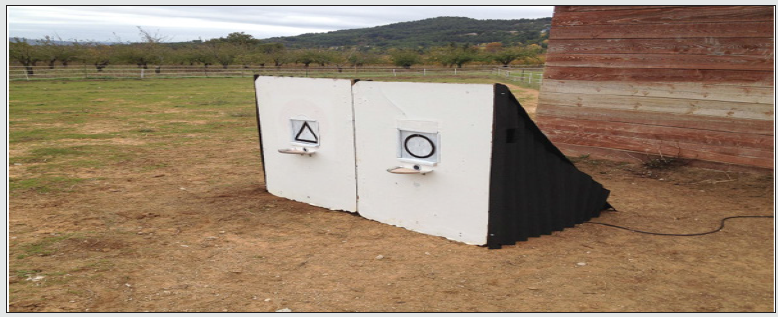
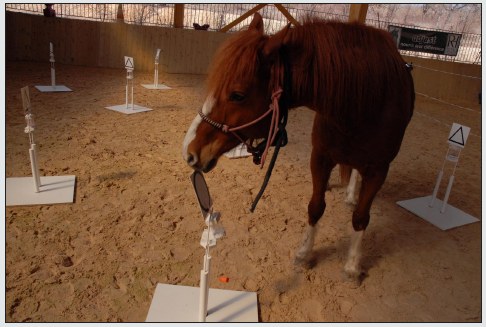
“Philbox”, the dispositive adapted and he was used for the LA in this experiment (Figure 1). The device consisted of two white panels; removable black shapes (a circle or a triangle) could be placed in front of the panels, and a hidden operator could insert treats on a food tray through a hole under each shape. A second operator led the horses to the panels. Ten “Pesadelo” devices were created to test the equine generalisation abilities (Figure 2). Each of these devices included a tilting mechanism, with one black shape painted on a white panel on the top (5 had a circle, and 5 had a triangle) and an inverted container on the bottom. Treats were placed in the containers, which each had a cover. For all devices marked by a circle, this cover was pierced such that the treats fell on the ground when the animals pushed or pulled the panel. For devices marked by a triangle, the cover was intact, so the treats did not fall when the animal pushed or pulled the panel. Some holes were created on the container to ensure that both devices had the same odour, regardless of cover type. There was a tray under each container. No operators were needed to run this device.

Figure 1: Philbox. The Philbox is a modified device for performing cognitive tests. The Philbox includes two removable geometrical shapes (circle and triangle) and a hidden operator who provides treats when the animals touch the panel with the correct shape.

Lupinepublishers-openaccess-journals-psychology-behavioral-science

Figure 2: Pesadelo. A Pesadelo is a device created to perform cognitive tests. The device includes a tilting mechanism with a shape-marked panel on one side and a treat in a container on the other side. To obtain the treat, a horse must push the panel (circle or triangle), such that the shape-marked panel tilts down and forward, the container tilts up and backward, and the treat drops onto the floor.

Lupinepublishers-openaccess-journals-psychology-behavioral-science

Procedure

A habituation session to the Philbox device was performed, as described. The setting was presented to the subjects, and spontaneous approaches and interactions with the device were rewarded with a treat. The session consisted of twelve efforts with the shapes removed from the devices. The initial phase of the session included 6 attempts (3 on the right and 3 on the left) using a treat on the panels as a lure; an additional reward was given each time the horses touched the panels. The horses then made 6 more attempts, for which they received a reward only upon touching the panels. A habituation session for the Pesadelo device was also performed to show horses the mechanism of pushing/pulling the panel to obtain treats. For this session, two devices with the shape panel replaced by a whole white panel were used. Horses were given 3 minutes of free contact with the two devices, in which any spontaneous contact with the panel was reinforced with a treat that felt from the container. For this purpose, each time a horse obtained a treat, an operator led the horse to the other device, while a second operator refilled the empty container with treats.

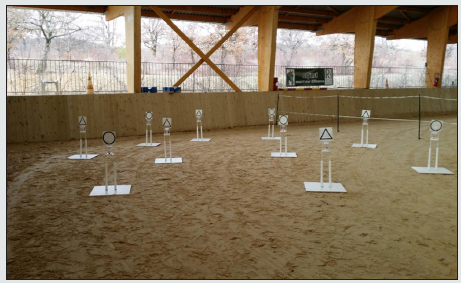
The LA were performed using the Philbox device and lasted five minutes for each horse. Horses had the possibility to choose between the shapes and received a reward (food treat) upon touching the correct shape (always the circle) with their noses (positive reinforcement). The development of a side preference was avoided by following predefined sequences of four figures, with a randomised order of appearance, thus avoiding any recognisable pattern. In addition, a food treat was hidden behind each shape to provide the same olfactory cue for both the circle and triangle. There was no limit to the number of attempts horses could perform during the 5 minutes of the test. Once a choice was made, horses were walked around by the operator and returned to the starting position. Thus, the horses that made choices faster could perform more attempts during the 5 minutes of the test. Each horse was led to a distance of 1.5 metres in front of the panels and then freed to interact with the setting. The operator stopped at 1.5 metres, stayed in a neutral position, and did not interact with the animal until a choice was made. Horses that made 70% or more correct choices, with at least 4 consecutive correct choices, were subsequently included in the GT. There was a time lapse of 48 hours between the two tests for all horses. The GT lasted 5 minutes for each horse. The setting consisted of ten Pesadelo devices (5 circles and 5 triangles) placed in a controlled testing area inside of a riding arena (Figure 3). Each device provided only one treat. The devices were randomly positioned in the setting area to permit the horse to easily access the two options (triangle and circle). Each horse was completely free in the testing area, and the operator left the riding arena and the visual field of the horse. The performance parameters for both tests included correct and incorrect choices and the total number of choices. For the GT, a choice was considered correct both the first and second time a horse pushed/pulled the same panel with a circle, even if the treat reward was only achieved during the first interaction. The same rule was applied for incorrect choices. If the horse returned to the same device a third time, that choice was not considered, neither correct or incorrect. Each horse was considered its own control.

Figure 3: Generalisation test setting. Ten Pesadelo devices were positioned in a controlled area to test equine generalisation capacities.

Lupinepublishers-openaccess-journals-psychology-behavioral-science

Statistical Analysis

Statistical analysis was carried out using 9.4 SAS software (2002-2012 by SAS Institute Inc., Cary, NC, USA). The significance threshold was classically fixed at 5%. Comparisons among the horses’ performances during the LA and the GT involved paired samples. To use the paired Student’s t test, normality was tested on the difference of the results in the LA and in the GT for the following parameters: “correct choices”, “incorrect choices” and “total number of choices”. For the “correct choices”, assumption of normality was not verified, so the non-parametric signed-rank Wilcoxon test was preferred. Normality was verified for “incorrect choices” and “total number of choices”; hence, the parametric Student t test was used.

Results

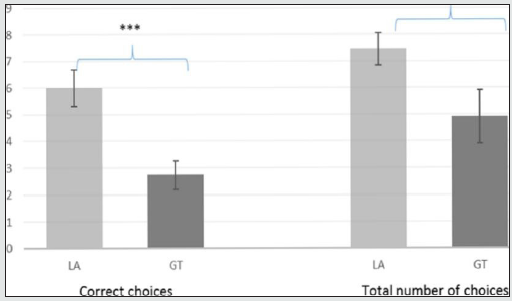
From the 16 initial horses, five did not learn the discriminative rule, so they were not included in the GT. The final population of horses comprised 11 subjects (7 geldings; 4 females). Only these horses were considered for the statistical analysis. Figure 4 compares these horses’ performances between the two tests. A significant difference in the number of correct choices between the learning activity and the generalisation test was observed (Wilcoxon Signed-Rank test, S=-33; p=0.001; LA: median=6, min=3, max=9; GT: median=3, min=0, max=5). Horses made two times fewer correct choices in the GT than in the LA. There was no significant difference in the number of incorrect choices between the two tests (Student’s t test, t=-0.91; DF=10; p=0.384).

Figure 4: Comparison of horses’ performances in the two tests (mean ± SD of choices). The learning activity is represented by light grey, and the generalisation test is represented by dark grey. ***: highly significant p-value, p=0.001; *: significant p-value, p<0.05.

Lupinepublishers-openaccess-journals-psychology-behavioral-science

A significant difference was observed in the total number of choices between the two tests, (Student’s t test, t=2.56; DF=10; p<0.05). Horses made a greater number of choices in the LA than in the GT.

Discussion and Conclusion

This experiment showed that horses who learned a specific discrimination task had a lower performance when the task was presented for the first time in a different context and setting. This result was emphasised by the decrease in the total number of choices and the number of correct choices between the learning and the GTs. The absence of a significant difference in the incorrect choices between the tests was probably related to the reduced total number of choices in the GT when compared to the LA. Horses made fewer attempts in the GT and often chose the wrong shape or device. The decrease in the horses’ performance between tests suggests that the generalisation of a learned task between contexts might require training and repetition. Even if the discriminative rule had been the same in both tests, the setting was completely different. The GT involved a three-dimensional setting with multiple devices, with only one positive reinforcement per device. For the LA, horses had panels simultaneously presenting all possible choices in their visual field, while for the GT, it was essential for horses to walk between the devices to reach all of them. The new context of the test can have impacted the performance in the GT. In addition, for the LA, an operator was always present. His presence could have represented a help for the animal. However, in our study, the operators were trained to stay in a neutral position and avoid any interaction with the horses to prevent them from influencing the horses’ choices. One could argue that the time (i.e. 48h) between tests could have a role in memorisation and, consequently, the generalisation of the rule. Nevertheless, memory in horses seems to be reliable and longlasting through life, as described by Hanggi and Ingersoll (2009).

Our results differ from those of Christensen et al. (2008), who conducted a study in which horses were submitted to a GT between stationary objects of the same colour with varying shapes in the same setting conditions. That study changed the rewarded shape between tests, while in the present study, the rewarded shape (the circle) remained the same between tests, but the setting was changed. Therefore, the generalisation of a well-known stimulus might depend on the context and environment [20]. This hypothesis is supported by the results, who created a setting with a lever near two buckets in an area open to horses. Horses learned that once they pressed the lever, they could have a food reward. Then, in a Y-maze test, a lever pointed to the direction of the correct side of the maze, where horses could find a food reward. They found that horses’ performance decreased from the bucket test to the Y-maze test. Even if the rule, i.e. the presence of a lever, was the same to obtain a food reward in both tests, the manner to follow the rule was different. Indeed, horses are accustomed to exploring new objects by touching or licking them; therefore, the exploratory behaviour of horses may have spontaneously provided the manners to use the lever to get a reward. However, in the Y-maze, this natural behaviour does not lead to any reward, so horses probably needed to find new coping strategies, which requires time and experience. Conversely, in our study, horses could obtain the reward by following the same rule with the same manner in the two tests, i.e. by pressing on a circle, which provided the same reliable information that horses could use for both tests. We observed a decrease in horses’ performances between the two tests, indicating that context features other than the manner to follow the rule can influence the generalisation abilities of horses.

Research findings are of great importance and should be considered in equine welfare and management because these findings often contradict commonly held beliefs about equine cognition and learning abilities [10-16]. Horses are part of a worldwide market and are moved across countries, which often implies regrouping with other conspecifics [18].

The ease of habituation to new living conditions is a serious welfare concern in horses that often results in misunderstandings in the human-horse relationship [4,6]. For example, if a horse is moved to novel husbandry conditions, its behavioural response to a well-known stimulus and the resulting coping strategies could be different from the original response and strategies, and these differences could be justified by the context modification, regardless of the horse’s previous habituation to that stimulus. The same problem could occur during competition because horses must perform previously learned exercises in new contexts [5]. In conclusion, this experiment suggested some limits in the capacity of horses to generalise a well-known task to different contexts. This study demonstrated that horses’ perception of different stimuli is context specific. Increasing our knowledge about the generalisation abilities of these animals is of great importance to improve equine management and training. Further research is still needed to fully understand horses’ generalisation abilities, especially focusing on the ability to generalise similar information in the same context, and to measure the influence of this ability on equine management and training.


https://lupinepublishers.com/psychology-behavioral-science-journal/fulltext/generalisation-abilities-of-learned-tasks-in-horses.ID.000214.php

https://lupinepublishers.com/psychology-behavioral-science-journal/pdf/SJPBS.MS.ID.000214.pdf

For more Lupine Publishers Open Access Journals Please visit our website: https://lupinepublishersgroup.com/

For more Psychology And Behavioral Sciences Please Click 

Here: https://lupinepublishers.com/psychology-behavioral-science-journal/

To Know more Open Access Publishers Click on Lupine Publishers

Follow on Linkedin : https://www.linkedin.com/company/lupinepublishers

Follow on Twitter   :  https://twitter.com/lupine_online


Locus of Control and Vulnerability to Peer Pressure: a Study of Adolescent Behavior in Urban Ghanaian Context

  Abstract Peer pressure is one thing that every individual is vulnerable to and has faced before at some point in their lives. It is beco...